
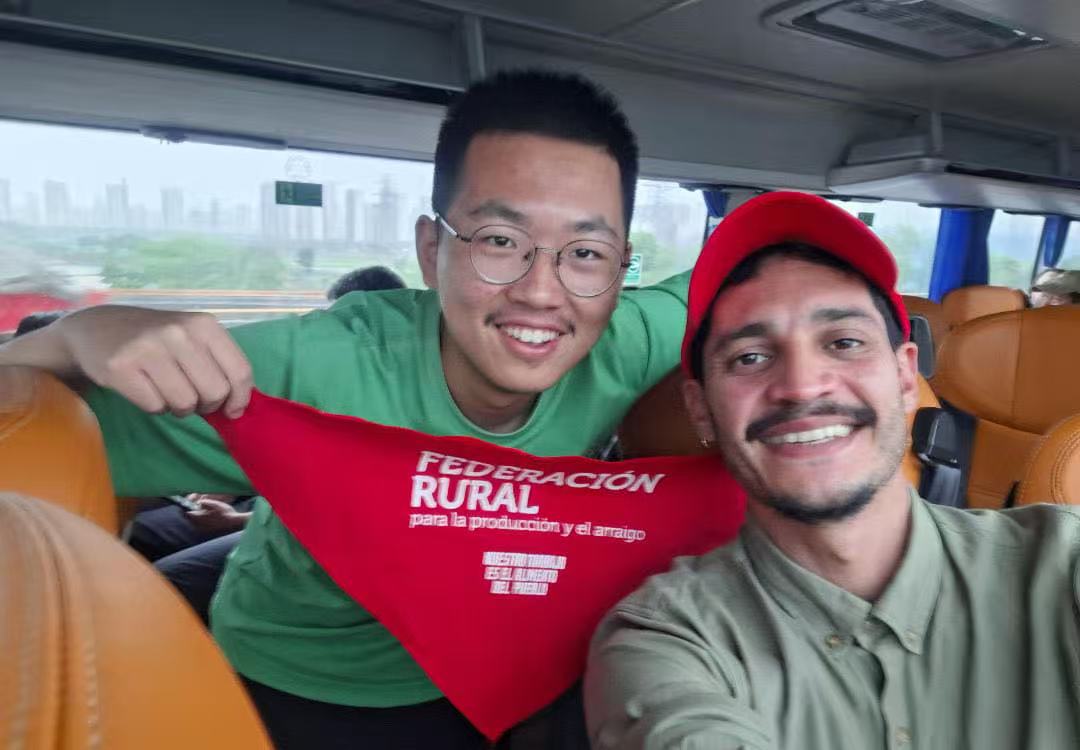
On the Pampas plains of South America, Argentina is often hailed as the “breadbasket of the world.” However, beneath this breadbasket’s shadow, a group of people struggle for basic sustenance and land efficiency. Recently, China Agricultural University welcomed a special group of transoceanic scholars. In a conference room, we met Hernan, an agricultural technical coordinator from Argentina. He had dark skin, resolute eyes, and carried a complete set of yerba mate. Through his story, we were able to unveil the grand narrative of geopolitics and delve into the most authentic predicaments and hopes of an ordinary South American agricultural worker.
A Technical Coordinator Emerging from the Land: Hernan was born and works in Mar del Plata, a coastal city in western Buenos Aires Province, Argentina. This city is not only a famous seaside tourist destination in Argentina but also a major national center for horticulture and vegetable cultivation. Today, he works as a technical facilitator at a horticultural cooperative under the Argentine Rural Cooperative Federation. He travels daily between different farms and greenhouses, helping smallholder farmers improve their planting techniques, coordinating cooperative affairs, connecting them with the market, and handling various practical problems encountered in production. In his view, Argentina has never lacked land, nor young people willing to dedicate themselves to the land; what it truly lacks is a cooperative mechanism to connect these people, and the practical conditions necessary for the long-term stable development of agriculture. This is why he chooses to stay in the fields, hoping to make the cooperative a bridge connecting farmers, the market, and the future.
Argentina’s Rising Agricultural Dilemmas and Challenges: Hernan’s tone noticeably somber when discussing Argentina’s development challenges. In the minds of many foreigners, Argentina possesses enviable natural endowments: vast, fertile land, abundant fishery resources, and climatic conditions sufficient to support large-scale agricultural production. However, in reality, this bountiful land has not provided a stable and prosperous life for everyone. In recent years, continuous economic fluctuations and a highly market-driven environment have placed increasing pressure on many ordinary families. Hernan noted that many regions suffer from a chronic lack of stable employment opportunities, forcing some families to work multiple jobs to make ends meet. Despite Argentina’s status as a major food producer, he observed that many struggle to afford daily meals, and the high cost of living and limited financial support make homeownership difficult for many young people. Simultaneously, a large influx of people and resources into a few major cities is placing increasing pressure on urban areas, while many rural areas suffer from land idling and resource waste due to a lack of public investment, infrastructure, and technological support. In Hernan’s view, this contradiction is one of the core problems facing Argentina today: “The free market tends to favor those with capital, while small farmers have virtually no ability to withstand risks when facing technological barriers and financial pressures. We possess abundant resources, yet we haven’t ensured that these resources truly benefit everyone.”
Why China? After arriving in China, Hernan discovered that rural development there doesn’t rely solely on individual farmers, but rather on a highly organized, multi-faceted cooperative system. Technology, finance, and sales channels are closely connected to farmers, enabling small farmers to access larger markets and achieve stable production and sustainable development. In his view, this development model, which integrates various resources through cooperatives, has high reference value for Argentine cooperatives that have long faced problems such as loose organization and insufficient funds. During his study tour at China Agricultural University, Hernan focused on ecological agricultural technologies such as composting. He believes that Argentina has vast land, but due to insufficient agricultural technology and high production costs, it is difficult to fully realize the potential of its land. China, through practices such as waste resource utilization, soil improvement, and increased land productivity, provides agriculture with a relatively low-cost and easily promoted solution. These technologies not only help increase yields but also align with the concept of sustainable development, making them very suitable for promotion and application in Argentine horticultural cooperatives.
After the interview, Hernan refilled his thermos with hot water and continued brewing his mate tea. In Argentina, people often sit together, sharing the same cup and straw. For them, mate tea is not just a beverage but also a way of sharing and communication. Hernan spent several months specifically learning English before coming to China for this study tour. Although we still encountered many language barriers during our exchanges, he persisted in communicating with those around him and diligently recorded everything he saw in China. From cooperative development models to composting technology and rural industrial layout, he hopes to bring these experiences back to Argentina and share them with more farmers and cooperative members. He said that Argentina possesses abundant land, mineral, marine, and agricultural resources; what it truly lacks is not resources, but rather the technology and organizational methods to better serve ordinary people. This is also why he came to China. For him, this journey is not a simple visit, but rather an effort to ensure that more local residents have enough to eat. Hernan is particularly interested in China’s development model. China not only emphasizes the development of large cities but also continuously promotes the extension of industry, technology, and employment opportunities to counties and rural areas, enabling more people to obtain work and development opportunities in their hometowns. In his view, this more balanced approach to regional development can alleviate the pressure caused by over-concentration of population and provides a new direction for thinking about Argentina’s long-standing problems of urban population concentration and insufficient rural development. Therefore, he hopes to bring the experiences he has seen in China back to Argentina, combining them with local realities to explore a development path suitable for his own country.
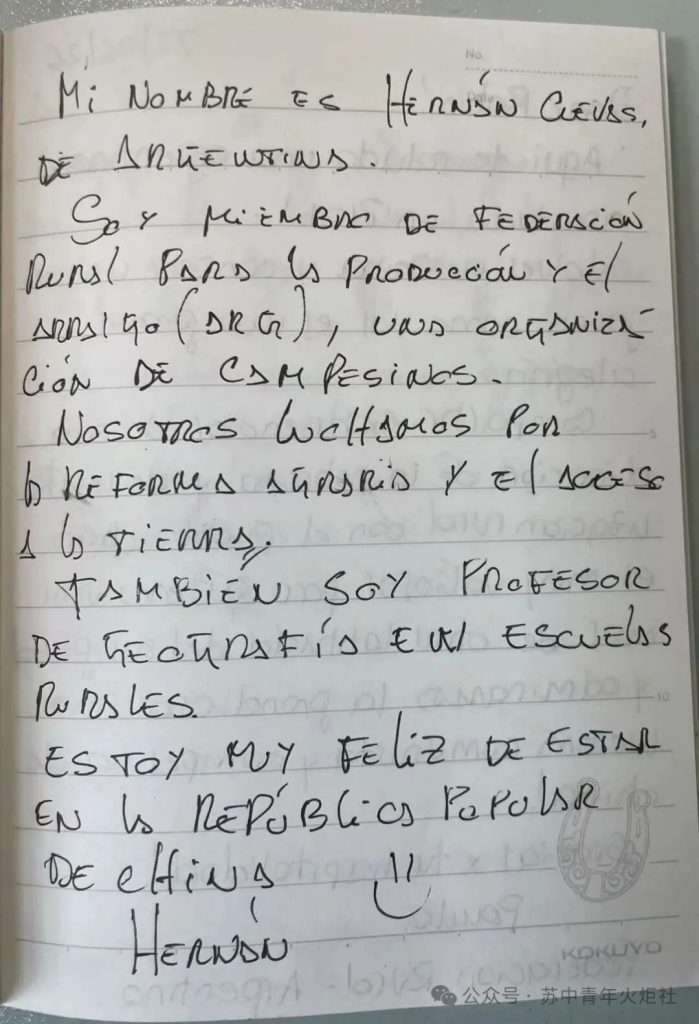
My name is Hernán Cuevas, and I’m from Argentina. I’m a member of the Rural Production and Rooting Federation (FRG), a farmers’ organization. We fight for land reform and the right to land. I’m also a geography teacher in a rural school. I’m very happy to be in the People’s Republic of China.
Hernán 🙂

Hernan’s colleague, Paula, who is also a Senior Coordinator at the International Southern Cooperation Organization (SSC):
Dear Robin, Greetings from an Argentinian residing in Brazil. It is a great pleasure to return to China and meet young people like yourself. Sharing our experiences in poverty alleviation and rural revitalization with the Chinese people is invaluable for those of us from other parts of the Global South who admire China’s great communism and peasant revolution! Thank you for your hospitality!
Paula, Federalación Rural – Argentina