
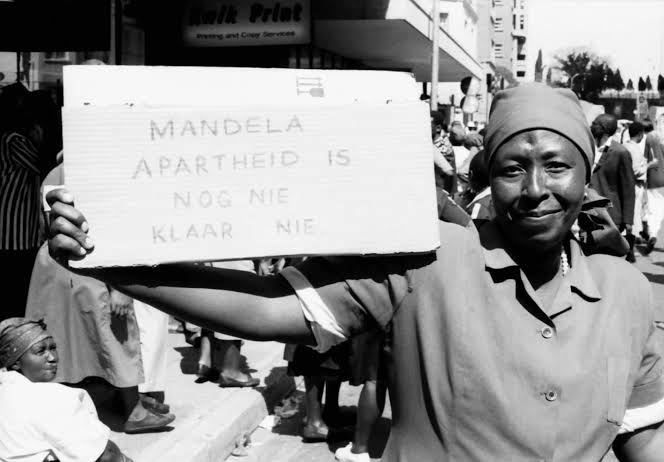
Numerous works serve to abolish of the cruel apartheid system in South Africa, including literature works
and speeches. One prominent example of literature was Nadine Gordimer’s A Chip of Glass Ruby, which
won the Nobel Prize in Literature in 1991. Gordimer was a writer who wrote novels to deliver a political
message for readers, specifically anti-apartheid movements. In the book she depicted Mrs. Bamjee, who
was caring for people and asked for the end of apartheid and discrimination. Gordimer carefully showed
Mrs. Bamjee’s universal kindness and pursuing justice within her optimistic and determined dialogues and
her calm actions, appealing to the audience’s pathos. Another Nobel Prize winner Desmond Tutu, the first
black archbishop in Cape Town, delivered a speech to United Nations Security Council after he won the
Nobel Peace Prize in 1984. Tutu utilized parallelism and strong connotations to directly stress the richness of
South Africa but also how apartheid brought injustice, violence and unrest to his beloved homeland.
Ultimately, Gordimer created Mrs. Bamjee as a model for brave anti-apartheid activists and persuade people
to fight against injustice through subtle literary elements and emotional connections, rather indirectly; On
the other hand, Tutu gave a direct speech using repetition and connotations to introduce several contrasts
between richness and violence in South Africa to make the world leaders pay attention to the issue.
Many dialogues from A Chip of Glass Ruby could generate emotional connections between Mrs. Bamjee
and readers, especially the ones right before Mrs. Bamjee was arrested. Mrs. Bamjee spoke out short and
simple sentences to inform the plans for weekend to Mr. Bamjee: “Take them on Sunday”. “To the
engagement party”. “They shouldn’t miss it. Ismail would be offended”. Such sentences made readers feel as
if she was experiencing a normal comfortable weekend. In contrast, she was facing the cruel police and
would be sent to prison right away. The tone is rather shocking, silent and a bit desperate, which revealed
Mrs. Bamkee’s preparedness for sacrifice for political development without hesitation. It also showed her
kindness. As overreactions would shock their children, she hid her feelings in her last words and ensured
their kids could live normally with the loss of their mother. Mrs. Bamjee was a paradigm for political activists
and demonstrated women’s power in political activities. It suggested that the power of anti-apartheid would
never end until the root was demolished.
Tutu, on the other hand, established long sentence syntax in his powerful speech. He utilized vivid imageries
in his mind, quoted “a beautiful land of rolling hills, and gurgling streams… a land of vast open spaces… a
land capable of feeding itself” to state his confidence and virtuous richness in South Africa. Conversely, he
claimed that his beloved country was ruined “by alienation, by animosity, by separation…”. He also wrote
“There is” structure to describe the volatile situation of restricted freedom and recession of economy. The
parallelism syntax demonstrated the material and spiritual development and richness of South Africa, but
also numerous harmful forces that render it a fragmented and desperate society. The strong contrast
emphasizes the horror and negative changes brought by the apartheid and call upon world leaders to care
about global humanity, abolishment of discrimination and freedom, making enormous changes to South
Africa government and create a just South Africa society.
Considering diction and pathos, Tutu also included words with strong connotations to create a tone of
anger, resentfulness and desperation. He repeated the words “volatile, unrest and endemic” to convey the
seriousness of the problem in South Africa. He also included positive words like peace, harmony and
contentment, again to stress the huge malicious effects stemmed from the apartheid. He ended the whole
speech with several adjectives: “And the root cause is apartheid – a vicious, immoral and totally unchristian
system…”. The powerful words aimed to shock the world about the real situations in South Africa. Anyway,
his speech was simply comprehensible by whether ordinary people and world leaders, repeatedly express
his will to give an end to apartheid.
-Quick Write, by Charles Yang, Co-founder of Youth Torch