
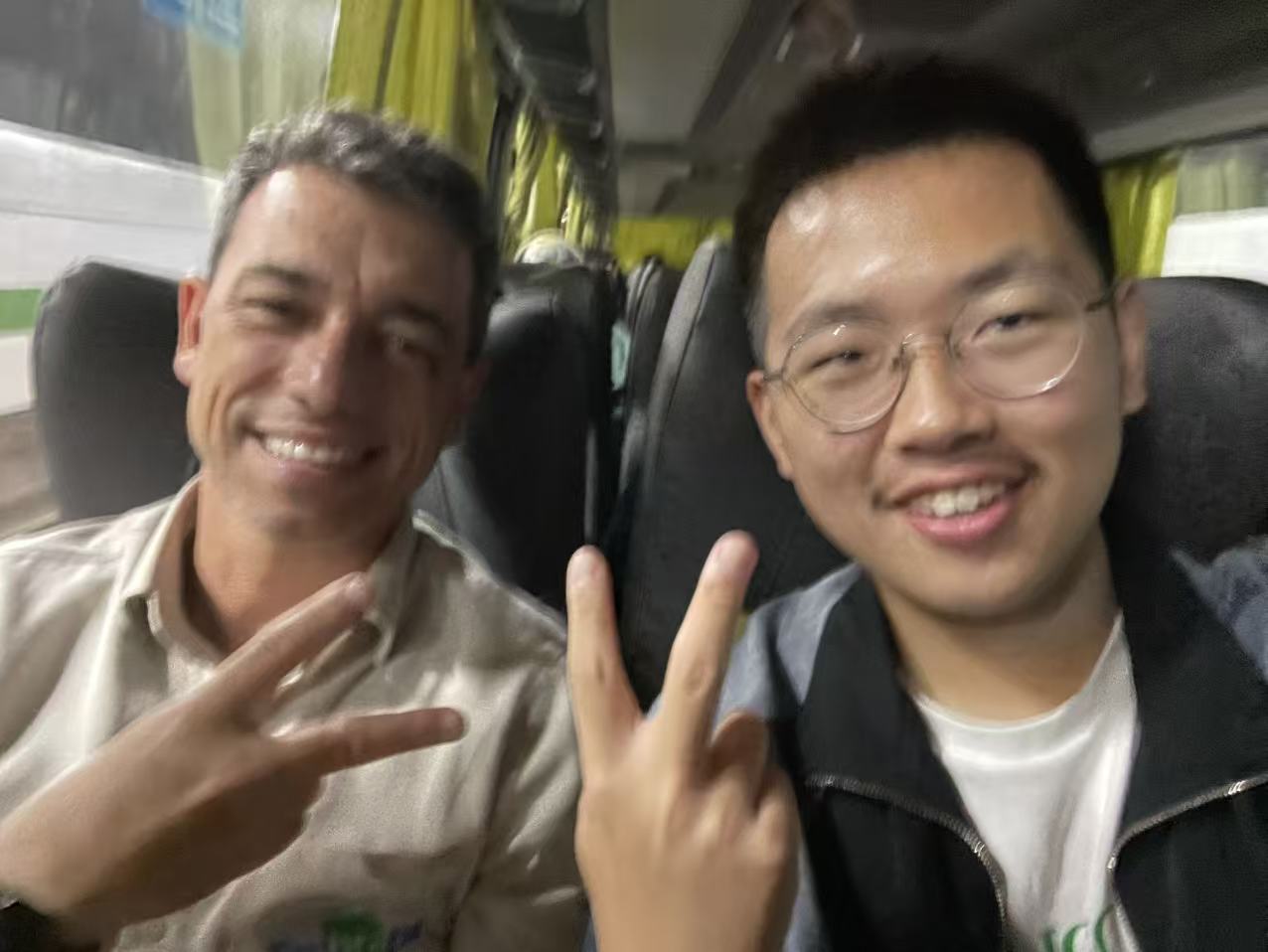
The crisp sound of glass bottles moving across a wooden table marked the beginning of my conversation with Caio in the rural school classroom. This was my last day here, and his last night. Last time, I spoke with Mariana, a Brazilian official, about Brazil’s macro-level ecological governance and institutional resilience; this time, sitting across from me was Caio, a frontline researcher from the Brazilian Institute of Agricultural Research (EMBRAPA). Having published at least 41 papers (ResearchGate data), his research focuses on nutrient and carbon cycling, sustainable fertilizer management, composting technology, and the application of stable isotopes in agricultural research. He is currently leading a research project on the potential of struvite slow-release phosphate fertilizer in Brazilian soils.
Why come to China? “There are so many developed countries in the world, why choose China?” Caio told me that he was invited by professors from both China and Brazil to Suzhou for training under the South-South Cooperation framework, representing EMBRAPA. As a scientist who has long studied carbon cycling in tropical and subtropical regions, Caio said that composting is not new in Brazil; they have been exploring it for two or three decades. However, what sets China apart from Brazil is the strategic resolve and planning of its government. “China has invested huge sums of money and is systematically and step-by-step cultivating a massive organic recycling market, effectively solving the problem of waste management,” Caio exclaimed. “Even more incredible is that China even has a dedicated organic recycling research institute. In Brazil, similar environmental attempts are often small-scale and scattered, lacking national-level professional research and development. Why can’t we just send kitchen waste directly to be burned? Due to limited phone storage space, I couldn’t record this part of the question, so I’ll have to supplement it with text.”
I asked Caio what the biggest bottleneck is in Brazil’s promotion of environmental technologies. His answer gave me a new understanding of waste management: it’s not a lack of technology, but rather that traditional landfills are too cheap. “From a commercial perspective, it’s difficult to compete with cheap landfills. Because of the low cost, some companies and organizations are used to burying their waste.” “China has a different strategy. We choose to incinerate most of our municipal solid waste for power generation. However, a serious problem is that incinerators are most vulnerable to waste with high moisture content. If large amounts of highly moist kitchen waste (wet waste) are directly thrown into the incinerator, it will not only greatly reduce combustion efficiency but also damage the equipment. To solve this problem, China, while promoting waste sorting, has chosen to address the issue on two fronts: first, directly improving the processing efficiency of municipal solid waste; second, carrying out organic recycling, investing heavily in the sorting and composting of kitchen waste, separating the high-moisture but nutrient-rich organic matter, and transforming it into fertilizer that nourishes the soil.
Back in Brazil, what changes would you most like to promote? This scientist, who deals with isotopes every day, has also turned his attention to the most basic levels of Brazilian society.” Family farm owners. He hopes to bring the refined composting experience he learned in China back to Brazil, and together with his colleagues, start small to improve Brazilian soil and help farmers who depend on the land to increase yields and income. Whether it’s the government’s macro-level design or grassroots scientific research, rural revitalization and reform in both China and Brazil are helping ordinary people secure their livelihoods and improve our lives. We hope we can both forge our own path to green development. We also look forward to the ecological cooperation between China and Brazil going further and deeper through these repeated “two-way trips.”
P.S.: Caio has been trying hard to teach me Brazilian Portuguese these past few days. Although it’s difficult, I’ve learned some basic vocabulary before he left! Before he departed, I also organized his letters.
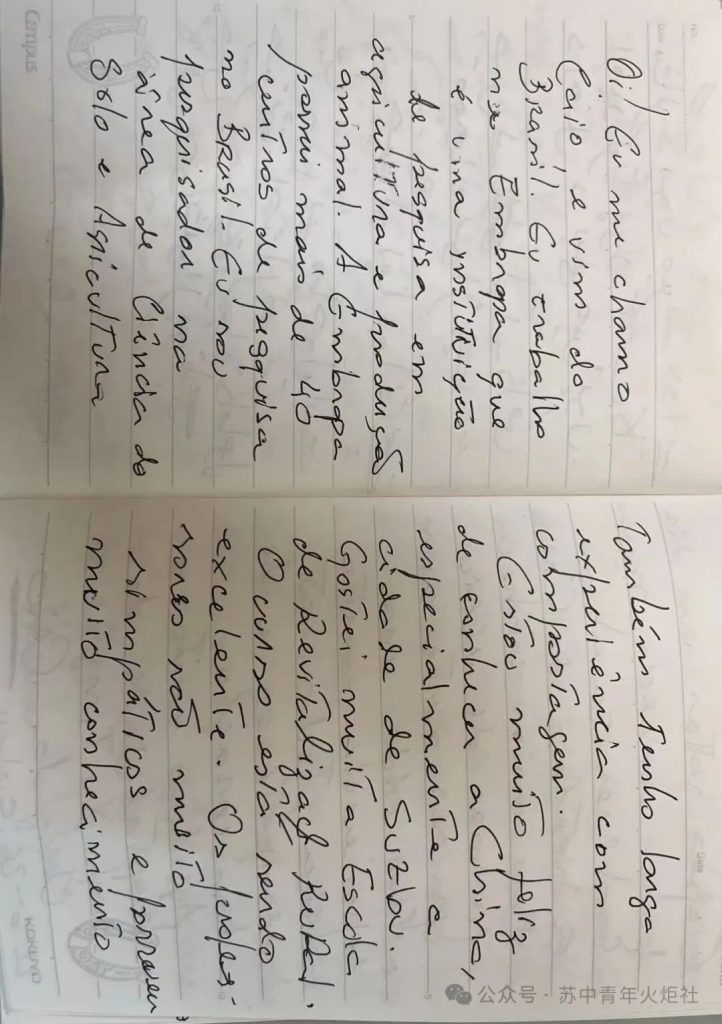
Hi! My name is Caio, and I’m from Brazil. I work at Embrapa (Brazilian Agricultural and Livestock Research Company), a research institution focused on agricultural and livestock production. Embrapa has over 40 research centers in Brazil. I’m a researcher in soil science and agriculture, and I also have extensive experience in composting. I’m delighted to have this opportunity to connect with China, especially Suzhou. I really enjoyed the Rural Revitalization School here. The course was fantastic. The teachers were incredibly enthusiastic, friendly, and possessed profound professional knowledge.
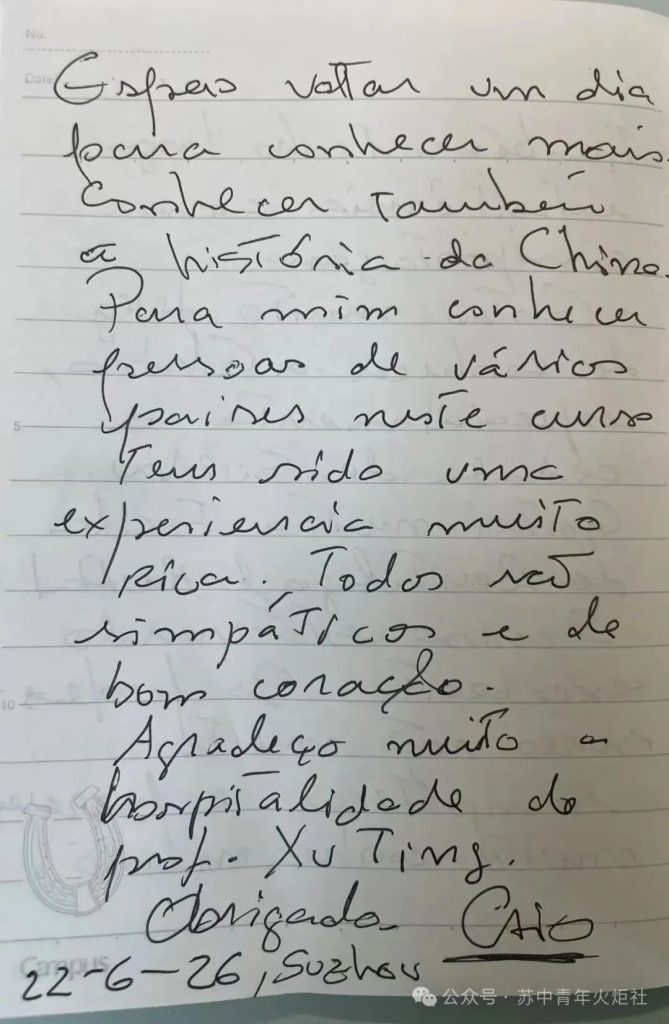
I hope to return someday to learn more about Chinese history. For me, meeting people from different countries in this course has been a very enriching experience. Everyone was friendly and kind-hearted. I am very grateful for Professor Xu Ting’s warm hospitality. Thank you.
— Caio, June 22, 2026, Suzhou